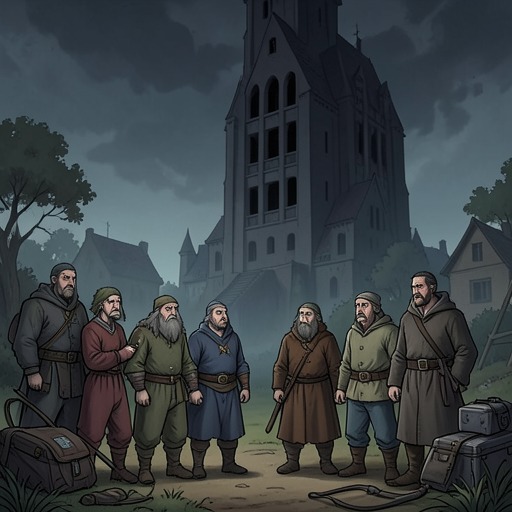
Their prison is only in their own minds
The Last Battle“Their prison is only in their own minds” is Aslan’s explanation of why the Dwarfs cannot be rescued from their own distrust. Their confinement is not imposed by a barrier: when he offers them a feast, they misperceive it as stable refuse, quarrel over it, and remain convinced that no one has deceived them. The phrase identifies a refusal of belief that becomes self-sealing: fear of being taken in prevents the Dwarfs from being taken out.
The phrase in its scene
The expression occurs after Aslan has returned and Lucy asks whether he can do anything for the Dwarfs. Aslan answers that he will show them both what he can and cannot do, then approaches and gives a low growl that makes the air shake. The Dwarfs explain the sound away as a trick by a gang at the other end of the Stable, supposedly produced by a machine. Their explanation is already a miniature of the prison: evidence reaches them, but they reinterpret it in advance as another attempt to deceive them.
Aslan then shakes his mane, and a splendid feast appears on the Dwarfs’ knees: pies, tongues, pigeons, trifles, and ices, with a goblet of wine for each. Yet the visible abundance does not become nourishment in their experience. They say they are eating hay, an old turnip, and a raw cabbage leaf; the rich red wine tastes to them like dirty water from a donkey’s trough. The scene makes their inward confinement tangible without turning it into a physical enclosure: the feast is present, but their perception cannot admit what is before them.
How suspicion sustains the prison
The Dwarfs do not merely fail to enjoy the meal. Each begins to suspect that another has received something better, and that suspicion drives them to grab and snatch. Their quarrel escalates into a free fight; food is smeared on their faces and clothes or trampled underfoot. When the fighting stops, they nurse black eyes and bleeding noses, yet conclude that at least there has been no “Humbug” and that nobody has taken them in. The bodily consequences of their distrust therefore do not dislodge the belief that sustains it.
This sequence gives the phrase its force as a causal account. The Dwarfs’ fear leads them to dismiss the growl, their distrust shapes what they taste, and their suspicion of one another destroys the feast. Even the result of their own violence becomes, in their telling, proof of independence from deception. Their prison is “only” in their minds in the sense that it is not a stable’s lock or a barrier keeping them from the feast; it is nevertheless real in its effects, because it governs what they can recognize and how they treat one another.
The Dwarfs’ maxim and Aslan’s judgment
After the fight, the Dwarfs announce, “The Dwarfs are for the Dwarfs.” Their maxim compresses their response to the feast into a claim of self-sufficiency: they would rather trust their own suspicion than accept aid from outside their group. Aslan names the choice directly, telling the children that the Dwarfs will not let him help them and have chosen cunning instead of belief. His account links their confinement not simply to mistaken senses but to a refusal of trust that persists even when he acts openly in front of them.
The expression also clarifies the limit of Aslan’s power in this episode. He can make food and wine appear, but he does not force the Dwarfs to perceive them as a feast or to receive his help. The contrast between the abundance he provides and the scraps they think they have exposes the difference between an offered gift and an accepted one. Aslan’s words to Lucy—that he will show her what he can and cannot do—frame the scene as a demonstration: his power can provide the feast, but it cannot make the Dwarfs willing to believe what they see.
Meaning and narrative function
The phrase turns the Stable scene from a simple deception into a study of closed interpretation. The Dwarfs suspect a trick before the feast appears, misread the feast when it does, and treat their ensuing quarrel as confirmation that they have not been fooled. Their certainty is not corrected by evidence because it absorbs contrary experience into its own terms. The scene’s irony rests on that reversal: the Dwarfs insist they have escaped deception while remaining unable to recognize the goodness directly before them.
Their self-made prison is therefore psychological and relational at once. Distrust restricts perception, but it also produces conflict among the Dwarfs themselves, converting shared food into competition and fellowship into blows. The phrase does not mean that their suffering is imaginary: they are left with black eyes, bleeding noses, and food underfoot. Rather, it names the mental conviction that keeps them from receiving help and makes those consequences possible. Aslan’s explanation gives the episode its moral distinction between protection against genuine deceit and suspicion so absolute that it closes off the possibility of truth.